

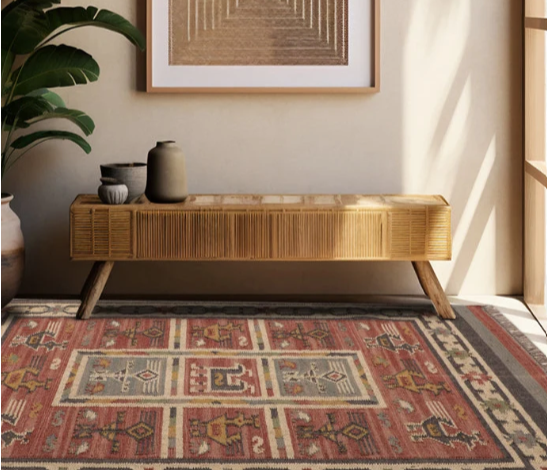
There is a curious contradiction in the way many living rooms are furnished. Considerable thought goes into selecting the flooring, whether it is white marble, polished granite, Kota stone or a large-format vitrified tile. Yet, once the furniture arrives, a large carpet is often introduced to cover much of that very surface.
The result is not always an improvement. A heavily veined marble floor can lose its visual character beneath a dense pattern. Decorative tiles may become almost invisible, while a small carpet placed in the middle of an otherwise expansive room can look disconnected from the furniture.
A living room floor carpet should do more than occupy empty flooring. It should establish a useful seating area, introduce a different surface underfoot, or provide a deliberate visual contrast. Knowing when to leave the floor exposed is equally important.
Indian Flooring Is Not One Uniform Design Canvas
The choice of carpet should begin with the flooring already installed.
In Rajasthan, Kota stone has a distinct grey-green appearance and is used in residential floors, courtyards, and other architectural settings. Makrana marble, by contrast, is known for its white appearance and subtle natural variation. Vitrified tiles offer a much wider range of printed patterns, colors, and finishes. These materials do not respond to decorative coverings in the same way.
Consider three common interiors:
- White or beige marble: Natural veining can contribute to the room’s visual composition. A smaller, restrained rug may provide a seating anchor without concealing the stone’s character.
- Patterned vitrified flooring: A heavily patterned carpet can compete with the floor’s existing design. A quieter surface may create a better balance.
- Kota stone or understated granite: A carefully chosen carpet can introduce color and a softer surface without requiring the entire floor to be covered.
The important distinction is between flooring that needs visual relief and flooring whose existing pattern deserves to remain visible.
Why Covering More Floor Does Not Always Improve the Room
A handmade carpet is often treated as a finishing layer, but its position changes how the room is perceived.
Take a living room with a carved wooden sofa, a central table, and patterned marble flooring. Placing a large Persian-inspired carpet beneath everything introduces another substantial visual element. If the furniture, carpet, and floor all have prominent patterns, the room can become visually congested.
A more restrained carpet may work better, particularly when the flooring already has strong veining or decorative inlay.
The reverse is equally true. A plain vitrified floor, uncomplicated upholstery, and minimal furniture can accommodate a more expressive Persian rug. The decision is not between a plain carpet and a patterned one. It is about deciding which surface should command attention.
The Carpet Should Also Respect How the Living Room Is Used
A formal drawing room with fixed furniture has different requirements from a family living room where people regularly move chairs, children play, and additional seating appears when relatives visit.
In a Mumbai apartment, where living and dining functions may share one floor, a carpet placed too close to the dining chairs can become an everyday inconvenience. In a larger Jaipur home with a separate drawing room, the carpet may have more freedom to function as a distinct design feature.
This changes the buying decision. Low-profile, firmly secured rugs for sitting room may be more appropriate where furniture moves frequently. A more substantial pile may suit a relatively fixed seating arrangement, provided its edges do not obstruct movement.
The point is to select a carpet for the room’s actual use, rather than assuming that every living room needs the same degree of floor coverage.
Can a Carpet Protect Marble and Other Finished Floors?
Yes, in certain circumstances, but protection depends on the flooring, carpet backing and maintenance.
An area rug can reduce direct contact from footwear and furniture in its covered area. However, dust and grit trapped beneath it may cause abrasion when the rug shifts. Some backings can also react with particular floor finishes.
Flooring manufacturers such as Shaw specifically advise using compatible, non-staining pads and avoiding moisture-trapping materials on certain laminate surfaces. Hardwood manufacturers similarly caution against unsuitable backing materials. These recommendations are surface-specific, not universal instructions for every Indian marble or tile floor.
Before placing a carpet:
- Check whether its backing is compatible with the flooring manufacturer’s recommendations.
- Use an appropriate underlay if the surface requires additional grip.
- Lift the carpet periodically to remove dust and inspect the floor.
- Dry both the carpet and the floor completely after spills.
- Check for uneven fading if the floor receives strong direct sunlight.
A carpet should never be used to conceal cracked tiles, loose flooring, or an underlying moisture problem. Those require repair, not decoration.
When Should You Choose a Statement Carpet, and When Should You Leave the Floor Alone?
A useful starting point is to identify what the room is missing.
| Existing living-room condition | More considered carpet choice |
| Strongly veined marble | Restrained pattern with a complementary palette |
| Decorative or patterned tiles | Subtle texture or a relatively quiet design |
| Plain granite or vitrified flooring | A more expressive pattern or color |
| Traditional wooden furniture | Persian-inspired or traditional motifs, depending on the upholstery |
| Contemporary neutral furniture | Geometric, abstract or textured designs |
These are starting points, not fixed combinations. The room’s lighting, wall colors and furniture finishes still matter.
For a design-led interior, wool rugs, hand knotted carpets and hand tufted rugs offer different construction and surface characteristics. The choice should reflect the intended placement, the level of daily use and the visual weight of the furniture.
A considered selection of living room rugs should begin with the floor and furniture already present, rather than treating the carpet as an isolated purchase.
Sometimes the Best Carpet Decision Is to Show More of the Floor
Indian homes have invested in a wide variety of flooring, from locally sourced natural stone to contemporary vitrified surfaces. Covering that investment indiscriminately makes little design sense.
A carpet earns its place when it introduces something the floor alone cannot provide: a defined seating zone, a more comfortable surface, or a deliberate contrast in color and texture.
It does not need to conceal every mark, every tile or every square foot. Sometimes, the most considered living room is the one that allows its flooring and carpet to be seen together.